
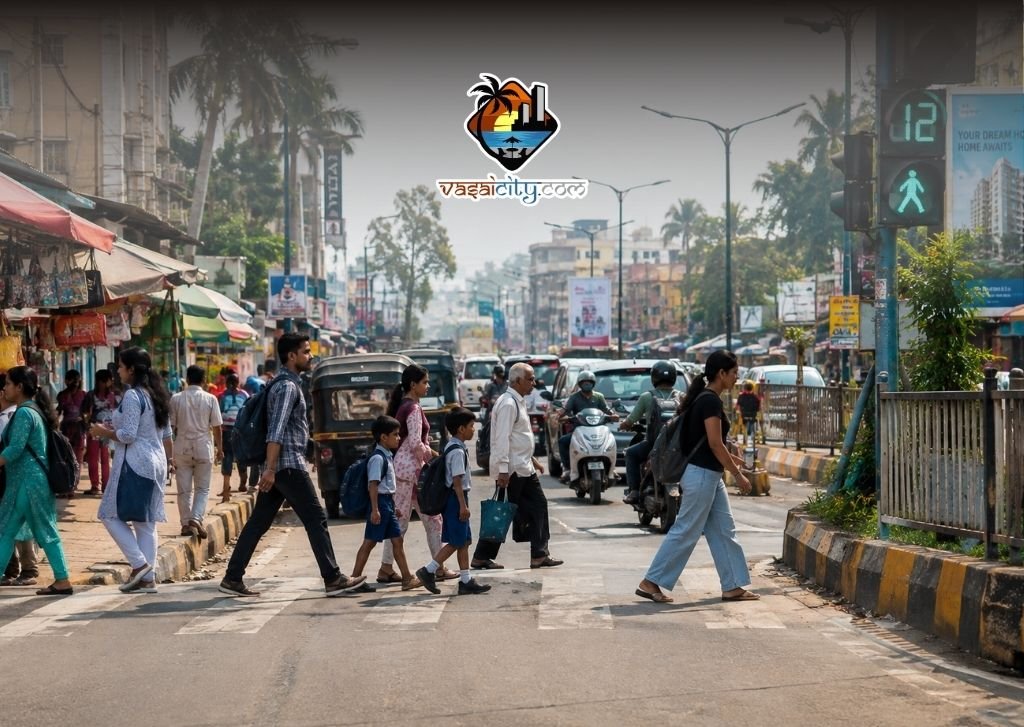
Pedestrian Safety in Vasai has become an important urban concern as busy roads, short pedestrian signal timings and obstructed footpaths make everyday walking increasingly difficult for residents.
Vasai has changed considerably over the years. What was once a collection of villages with a relatively relaxed pace of life has grown into a busy urban area with crowded markets, educational institutions, commercial establishments and expanding residential neighbourhoods.
But as the city grows, one basic question deserves greater attention: are its roads being designed only to move vehicles, or also to protect the people who walk on them?
For many residents, crossing a road has become a stressful part of daily life. At busy junctions, pedestrians may have only a short window to cross before the signal changes. Children, senior citizens, people carrying shopping bags and commuters who walk slowly can struggle to reach the other side in time.
When the countdown ends and traffic begins moving again, anyone still crossing may find themselves exposed to approaching vehicles.
These situations raise serious concerns about Pedestrian Safety in Vasai, particularly at junctions where vehicle movement, pedestrian crossings and roadside activity compete for limited space.
Table of Contents
Pedestrian Safety in Vasai: Are Signal Timings Adequate?
Traffic signals are intended to regulate the movement of vehicles and pedestrians. However, a signal system cannot serve its purpose effectively if people on foot are not given sufficient time to cross safely.
At some busy junctions in Vasai, residents may find pedestrian crossing time too short, especially during peak hours. The difficulty is greater for older people, young children, people with disabilities and anyone who cannot walk at a brisk pace.
A few extra seconds may appear insignificant to a motorist waiting at a red light. For a senior citizen attempting to cross a wide road, however, those seconds can make a meaningful difference.
Traffic authorities need to assess pedestrian crossing times according to the width of the road, the volume of people crossing and the needs of slower-moving pedestrians. Where necessary, signals should provide adequate crossing time and clear indications of when it is safe to cross.
The objective should not simply be to minimise delays for vehicles. It should be to allow everyone to use the road safely.
Why pedestrian-friendly signals matter
A well-designed signal system can help reduce conflicts between pedestrians and moving vehicles. Depending on the junction, practical measures may include dedicated pedestrian phases, clearly marked crossings, countdown timers and better coordination between traffic signals.
Authorities should also examine whether vehicles are permitted to turn across pedestrian crossings while people are crossing. Such movements can create additional risks if drivers do not yield.
Pedestrian Safety in Vasai should be evaluated at actual road junctions rather than assumed to be adequate simply because traffic signals have been installed.
Blocked Footpaths Force People onto Busy Roads
Another major challenge for pedestrians is the obstruction of footpaths.
Footpaths are meant to provide a dedicated and relatively safe space for people to walk. However, when these spaces are occupied by unauthorised hawking, parked vehicles, goods, signboards or other obstructions, pedestrians may have little choice but to step onto the road.
This creates a dangerous situation.
A person walking along the footpath may suddenly have to move into traffic to get past an obstruction. Drivers may not expect pedestrians to enter the carriageway at that point, particularly on busy roads or near junctions.
The problem is especially serious for children walking to school, older residents, people with mobility difficulties and commuters travelling with bags or small children.
Footpath encroachment is not merely an inconvenience. It can undermine the very purpose of providing pedestrian infrastructure.
Enforcement must go hand in hand with planning
The solution requires a balanced approach.
Municipal authorities should identify and clear dangerous obstructions while ensuring that legitimate street-vending activity is managed through appropriate planning and enforcement.
Where street vendors serve a genuine local need, designated vending areas and clearly defined pedestrian corridors can help reduce conflict.
Footpaths must remain sufficiently wide and unobstructed for people to walk safely. Ramps, tactile paving where appropriate, safe kerb transitions and continuity between adjoining footpaths are also important.
A footpath that suddenly disappears, narrows or is blocked halfway through a journey does not provide a reliable walking route.
For Pedestrian Safety in Vasai to improve, authorities need to consider the entire pedestrian journey, not just isolated stretches of pavement.
Why Walking Remains Essential in Vasai
Urban transport planning often focuses on cars, motorcycles, buses and trains. But walking remains an essential part of everyday travel, including for people who use other modes of transport.
Not every household can afford a private vehicle. Nor does every short journey justify booking an auto-rickshaw or another hired vehicle.
In Vasai, residents frequently walk to local shops, markets, eateries, schools, clinics, railway stations and other neighbourhood destinations.
Even people who own vehicles may choose to walk for short errands, particularly where parking is difficult or traffic congestion makes driving inconvenient.
This makes pedestrian infrastructure important across income groups.
Walking is not simply a choice made by people who do not own vehicles. It is part of almost every journey. A person travelling by train usually has to walk to the station, while someone using a car may still need to walk from a parking space to a shop or office.
Consequently, the quality of footpaths and crossings directly affects how convenient and accessible a neighbourhood is.
A city that encourages safe walking can also support local businesses, improve access to public transport and make neighbourhood streets more welcoming.
Markets, Schools and Shops Need Safer Walking Routes
Many of Vasai's markets, shops, educational institutions and other establishments are located along roads that also carry substantial traffic.
These roads bring together different users: pedestrians, two-wheelers, cars, buses, delivery vehicles, street vendors and people stopping to access nearby businesses.
Without proper planning, these competing activities can create congestion and safety problems.
Schoolchildren may need to cross busy roads during opening and closing hours. Shoppers may move between stores on opposite sides of a street. Senior citizens may need extra time to reach medical facilities or local markets.
In such areas, pedestrian safety should be treated as a core planning requirement.
Authorities can assess whether crossings are located where people naturally need to cross, whether footpaths remain usable throughout the day and whether vehicle speeds are appropriate for the surrounding activity.
Depending on local conditions, improvements could include raised crossings, refuge islands on wider roads, clearer road markings, better lighting, traffic calming and designated pick-up and drop-off areas.
These measures should be selected after a site-specific assessment rather than applied identically to every road.
The priority should be to make common walking routes safe and predictable.
Parking Shortages Can Make Walking More Difficult
Limited parking is another part of the urban mobility challenge.
When roadside parking occupies valuable road space, it can reduce visibility near crossings and force pedestrians to navigate between stationary and moving vehicles.
Poorly positioned parked vehicles can also obstruct drivers' views of children and other pedestrians preparing to cross.
At the same time, insufficient organised parking can lead to vehicles being left on footpaths or in areas intended for pedestrian movement.
This creates a difficult situation for everyone.
The answer is not simply to remove every vehicle from every street. Instead, parking needs to be managed in a way that preserves safe pedestrian access and maintains reasonable access to shops and other establishments.
Possible measures include clearly marked parking zones, restrictions near junctions and crossings, enforcement against footpath parking and loading arrangements for commercial areas.
For short local journeys, safe and continuous footpaths can also make walking a more practical alternative to taking a vehicle.
A well-managed street should accommodate its different users without allowing parking or traffic movement to overwhelm pedestrian needs.
Pedestrian Safety in Vasai Must Be Part of Infrastructure Planning
Vasai and the wider Vasai-Virar region continue to experience urban growth and investment in infrastructure.
Road improvements and transport projects are important, but the benefits of these investments should be assessed by looking at how people actually use the city.
A wider road may help vehicles move more efficiently, but if pedestrians cannot cross it safely, the improvement remains incomplete.
Similarly, installing traffic signals does not guarantee safety if crossing times are inadequate, drivers fail to yield or footpaths are obstructed.
Urban mobility must account for people of different ages and abilities. It should include safe walking routes, accessible public spaces and convenient connections between residential areas, markets, public transport and civic facilities.
The question is not whether vehicles or pedestrians deserve priority in every situation. It is whether the road system provides a safe and practical way for both to move, with appropriate protection for people who are most vulnerable in a collision.
Five practical steps that could improve pedestrian safety
1. Review pedestrian signal timings: Conduct junction-level assessments and provide sufficient crossing time for children, senior citizens and people with reduced mobility.
2. Keep footpaths clear: Enforce rules against dangerous encroachments and footpath parking while planning suitable spaces for street vending and commercial activity.
3. Improve crossings: Maintain visible road markings and consider raised crossings, refuge islands and other safety measures where road conditions justify them.
4. Manage traffic speeds: Introduce suitable traffic-calming measures near schools, markets, residential streets and other areas with heavy pedestrian movement.
5. Audit walking routes: Inspect complete routes between homes, schools, markets, railway stations and public facilities to identify gaps, obstructions, poor lighting and unsafe crossings.
These steps require coordination between the municipal corporation, traffic police, road-owning agencies and other relevant authorities. Regular inspections and public feedback can help identify locations where improvements are most urgently needed.
What Can Residents Do?
Residents can contribute by reporting obstructed footpaths, damaged crossings, malfunctioning pedestrian signals and dangerous junction conditions to the relevant civic or traffic authorities.
Photographs, precise location details and information about the time or circumstances of a recurring problem can make a complaint easier to investigate.
Pedestrians should also use marked crossings where available, avoid crossing against signals and remain alert around turning vehicles. These precautions are useful, but they cannot replace properly designed infrastructure and responsible driving.
Drivers, meanwhile, should approach crossings cautiously, yield to pedestrians where required and avoid blocking pedestrian routes while parking or waiting.
Public awareness matters, but responsibility for road safety must not be placed entirely on people walking. Authorities must provide safe infrastructure, and all road users must follow the rules.
For official road-safety information, readers can refer to the Ministry of Road Transport and Highways.
The Real Measure of a City Is How Safely People Can Walk
Vasai's growth brings opportunities, but it also creates an obligation to make everyday life safer and more convenient for residents.
For many people, a journey through the city begins with a walk to a bus stop, railway station, school, market or workplace. That short stretch should not become the most stressful part of the journey.
Pedestrian safety is not a secondary concern to be addressed after major infrastructure projects are completed. It is a basic requirement of a functional city.
Adequate crossing time, unobstructed footpaths, visible road markings, responsible parking and appropriate traffic management can make a meaningful difference to daily life.
The larger question for Vasai is straightforward: should urban mobility be measured only by how quickly vehicles move, or also by how safely residents can reach their destinations on foot?
A city that invests in safer walking routes recognises that streets are public spaces, not merely channels for moving traffic.
As Vasai continues to develop, pedestrians deserve to be part of the planning process — not left waiting in the middle of the road when the signal changes.
