
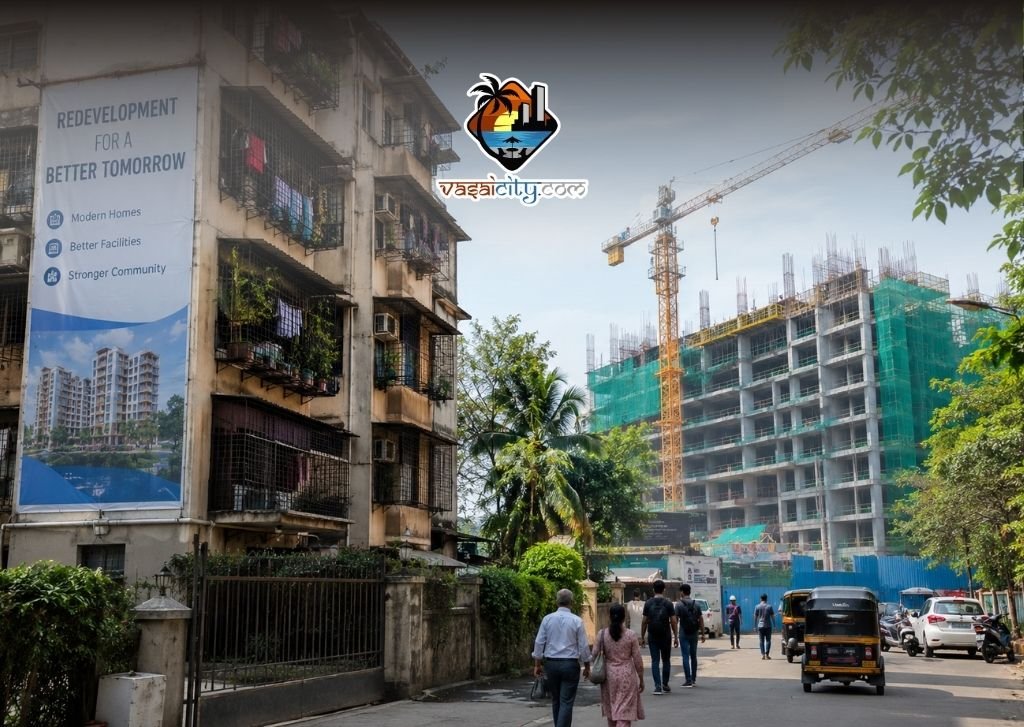
Vasai Redevelopment continues to face challenges despite policy reforms intended to simplify approvals, improve project viability and encourage the renewal of ageing residential buildings. Housing experts and residents are increasingly calling for stronger transparency, builder accountability and financial safeguards to ensure that redevelopment delivers safer homes without leaving flat owners trapped in disputes.
Across Vasai and the wider Vasai-Virar region, redevelopment is becoming an important part of the urban transformation process. Many residential buildings are ageing, while residents seek better living conditions, modern amenities and improved safety.
However, replacing an old building with a new one involves far more than construction. Society members must make important financial and legal decisions, select a developer, negotiate the terms of redevelopment and ensure that commitments are fulfilled over several years.
When the process lacks transparency or adequate oversight, disagreements can arise over developer selection, additional carpet area, transit rent, project timelines, construction quality and the final handover of homes.
The central question facing Vasai Redevelopment is therefore not simply how to speed up projects, but how to make them fair, financially secure and accountable to the residents whose homes are at stake.
Table of Contents
Vasai Redevelopment: Why Are Projects Struggling to Gain Momentum?
Redevelopment has long been viewed as a way to address ageing housing stock, make better use of urban land and improve residential infrastructure.
Policy changes introduced by the Maharashtra government over the years have sought to make redevelopment easier to undertake. These measures have addressed procedural requirements, cooperative housing society decisions and, in certain circumstances, self-redevelopment.
Yet regulatory changes alone cannot guarantee successful projects.
Redevelopment involves several stakeholders, including housing societies, individual flat owners, developers, architects, legal advisers, financial institutions and government authorities. Delays or disagreements at any stage can affect the entire project.
Residents may hesitate to approve redevelopment when they are uncertain about the developer's financial capacity, the additional area they will receive, the rent payable during construction or the consequences of a project delay.
Developers, meanwhile, may face challenges involving permissions, financing, construction costs and the commercial feasibility of a project.
These issues highlight the need for a system in which residents can independently verify important information before committing their homes and financial interests to a redevelopment agreement.
For Vasai Redevelopment to gain momentum, the process must combine practical approvals with enforceable safeguards for every affected flat owner.
1. Transparency Must Begin Before the Developer Is Selected
One of the most important decisions in any redevelopment project is the selection of the developer.
A housing society may receive proposals from multiple developers, each offering different terms relating to additional carpet area, rent, corpus payments, amenities, parking and project completion.
Comparing these proposals can be difficult if the information is incomplete or presented in different formats.
A developer offering the highest additional area may not necessarily be the strongest choice. Financial capacity, previous project performance, pending litigation, construction quality, delivery record and the ability to obtain necessary approvals are equally important.
Housing societies should therefore adopt a documented and competitive selection process.
E-tendering could help improve transparency by allowing eligible developers to submit comparable proposals through a structured process. Where legally and practically appropriate, societies could invite bids from financially qualified developers and publish the evaluation criteria to their members.
The selection process should record the proposals received, the criteria used to assess them, the reasons for rejecting unsuitable bids and the basis for the final decision.
However, e-tendering should not be treated as a universal statutory requirement unless a specific applicable rule or order makes it mandatory. Its use should be aligned with the legal framework governing the particular society and project.
For Vasai Redevelopment, the objective should be to prevent arbitrary decisions and ensure that society members understand why a particular developer has been selected.
2. Builder Accountability Must Be Enforceable
A redevelopment proposal can look attractive on paper. The real test comes when the developer must deliver the promised homes, facilities and financial benefits.
Flat owners may agree to vacate their existing homes on the basis of commitments concerning additional carpet area, temporary accommodation, monthly transit rent, shifting expenses, parking, amenities and completion timelines.
If these commitments are vaguely drafted or inadequately secured, residents may face difficulties when the project encounters delays or financial problems.
A strong redevelopment agreement should clearly specify the developer's obligations, the responsibilities of the housing society, the project milestones and the remedies available if commitments are breached.
Important provisions should address:
- The existing and proposed carpet area of each eligible flat.
- Transit rent, payment frequency and any agreed escalation.
- Shifting and other agreed financial assistance.
- The project schedule and key construction milestones.
- Responsibility for obtaining statutory approvals.
- Construction specifications, amenities and parking commitments.
- Consequences of delays and failure to meet contractual obligations.
- Security arrangements, where applicable, to protect members against specified risks.
- Procedures for resolving disputes and enforcing the agreement.
The agreement should be reviewed by an independent legal professional representing the society's interests before it is signed.
Builder accountability in Vasai Redevelopment must be based on written obligations and enforceable remedies, not verbal assurances or attractive presentations.
3. Financial Safeguards Should Protect Residents
Redevelopment projects often involve substantial financial commitments, while flat owners may have to leave their existing homes before the new building is ready.
That creates a period of vulnerability.
If a project stalls because of inadequate funding, insolvency, approval problems or disputes, residents may face prolonged uncertainty while paying for temporary accommodation or pursuing legal remedies.
Financial safeguards can reduce these risks, although no single measure can eliminate them completely.
Depending on the project's legal structure and applicable requirements, housing societies should examine whether appropriate bank guarantees, escrow arrangements, performance security or other financial protections are available and necessary.
An escrow arrangement, where legally appropriate, can help ensure that specified funds are used for agreed purposes. A bank guarantee may provide financial recourse if defined contractual conditions are breached.
However, residents should not assume that every redevelopment project is automatically subject to identical escrow or bank-guarantee requirements. The applicable obligations depend on the relevant regulations, approvals, agreements and project structure.
Before signing, societies should obtain independent advice on the developer's financial capacity, funding arrangements, liabilities and track record.
Quarterly financial or progress disclosures may also be useful where they are provided for in the agreement or required by applicable regulations.
For Vasai Redevelopment, financial safeguards should be designed around the actual risks of the project rather than added as generic clauses that are difficult to enforce.
4. Housing Society Meetings Need Proper Oversight
Redevelopment decisions can affect every member of a cooperative housing society for years.
This makes the quality of the decision-making process particularly important.
Members should receive adequate notice of meetings, relevant documents, competing proposals and clear explanations of the financial and legal implications of the proposed decision.
Minutes should accurately record the discussions, resolutions and voting outcomes. Members should also be able to access documents relevant to decisions affecting their homes and financial interests, subject to applicable law.
The role of the cooperative department and the Registrar of Cooperative Societies is another important consideration.
Maharashtra's cooperative housing framework contains provisions governing society meetings and redevelopment-related procedures. However, the precise requirements depend on the applicable government resolutions, rules, circulars and the circumstances of the particular society.
The presence of a Registrar or authorised official should not be described as a universal requirement for every redevelopment meeting without verifying the specific provision that applies.
Societies should obtain the latest applicable government resolution or official circular before relying on any particular procedural requirement.
The objective should be straightforward: every member must have a fair opportunity to understand the proposal, raise questions and participate in decisions according to the applicable rules.
5. Independent Audits and Progress Reports Can Build Trust
Residents should not have to depend entirely on the developer's verbal updates to understand the progress of their redevelopment project.
Independent verification can help identify problems before they become major disputes.
Depending on the project and contractual arrangements, housing societies can consider appointing independent technical consultants, architects, engineers, quantity surveyors or other qualified professionals to assess construction progress and compliance with agreed specifications.
Such professionals can review whether construction is progressing according to the approved plans, whether specified materials and standards are being followed and whether the work completed is consistent with the reported stage of development.
Financial reviews can also help members understand whether project-related payments and other financial commitments are being handled in accordance with the applicable agreements and requirements.
Regular progress reports could cover:
- Approvals received and approvals still pending.
- Construction milestones completed and outstanding.
- Changes to approved plans, where applicable.
- Payments due and payments made under the agreement.
- Transit rent and other member entitlements.
- Significant risks, delays or disputes requiring action.
These reports should be shared with society members through an agreed, accessible process.
Independent reviews cannot guarantee that a project will be completed on time. They can, however, give residents better information and create an early-warning mechanism when performance begins to fall behind expectations.
6. Dispute Resolution Must Be Faster and More Effective
Disagreements are not unusual in redevelopment projects.
A dispute may arise over the developer-selection process, consent, eligibility, the interpretation of an agreement, transit rent, additional carpet area, delays or the quality of construction.
When disputes remain unresolved, they can prevent work from progressing and increase costs for everyone involved.
A clear dispute-resolution mechanism should therefore be established before redevelopment begins.
The agreement should identify the process for raising grievances, the people responsible for addressing them, the time allowed for responses and the legal remedies available if negotiations fail.
Where appropriate, parties may consider structured negotiations, mediation or other legally recognised dispute-resolution mechanisms. These options should not prevent residents from approaching the competent statutory authority or court when the law permits or requires it.
The competent forum depends on the nature of the dispute, the parties involved and the applicable legal framework.
Residents should also distinguish between the role of a planning or redevelopment authority and the jurisdiction of a cooperative authority, regulator or court. A body that coordinates development planning does not necessarily have the power to decide every contractual or society-related dispute.
For Vasai Redevelopment, an accessible grievance mechanism could help resolve routine issues early while preserving the right to pursue formal remedies when necessary.
7. Residents Must Know Their Legal Rights
Housing society members should not be expected to navigate complex redevelopment decisions without professional guidance.
Before approving a proposal, residents should understand the relevant government resolutions, cooperative housing society requirements, development-control regulations and provisions governing the particular project.
They should also verify whether the project falls within the applicable provisions of the Real Estate (Regulation and Development) Act, 2016, commonly known as RERA, and whether registration or other compliance obligations apply.
RERA does not automatically apply in an identical manner to every redevelopment arrangement. Applicability depends on the project's structure, statutory conditions and relevant exemptions.
Where applicable, residents can examine the project's registration details, promoter disclosures and other information available through the relevant state regulator.
The official Maharashtra Real Estate Regulatory Authority (MahaRERA) website is a useful starting point for checking regulatory information and guidance.
Housing societies should also obtain independent legal advice before signing a development agreement or granting possession of the existing property.
Legal review should cover the complete agreement and its annexures, including plans, specifications, financial commitments, timelines, default provisions and dispute-resolution clauses.
Members should retain copies of the documents they are entitled to receive and ensure that important promises are recorded in writing.
Vasai Redevelopment Must Include Civic Infrastructure
Redevelopment is not only about replacing an old building with a new one.
The wider impact on the neighbourhood must also be considered.
As more buildings are redeveloped into larger residential structures, the number of residents and the demand for essential services may increase. If civic infrastructure does not expand accordingly, the resulting development could put additional pressure on roads, water supply, drainage, sewage systems and public facilities.
This is particularly important in parts of Vasai-Virar where residents already experience traffic congestion, waterlogging or other infrastructure challenges.
A redevelopment project may improve conditions for the residents of an individual building while contributing to wider problems if the surrounding infrastructure is inadequate.
Municipal planning therefore needs to consider the cumulative effect of multiple projects within the same locality.
Roads, drainage and transport
Roads and internal access routes must be suitable for the expected population and traffic movement.
Stormwater drainage needs to be assessed against local conditions to reduce the risk of waterlogging. Access for emergency vehicles must also be considered during planning and construction.
Public transport connections, pedestrian access and parking management are equally important in areas experiencing increasing residential density.
Water, sewage and public utilities
Higher population density can increase pressure on water distribution networks, sewage infrastructure and waste-management systems.
Authorities should assess whether existing networks can support proposed development and identify improvements required to maintain reliable services.
Fire-safety provisions, emergency access and other essential building requirements must also be addressed through the applicable approval process.
Schools, healthcare and public spaces
Growing residential populations create additional demand for schools, healthcare facilities, open spaces and other neighbourhood amenities.
These requirements should be considered as part of broader urban planning rather than left entirely to individual building projects.
The long-term success of Vasai Redevelopment will depend not only on the quality of new buildings, but also on whether the surrounding neighbourhood remains safe, accessible and liveable.
What Should Change to Make Vasai Redevelopment More Reliable?
Policy reforms can provide the framework for redevelopment, but successful implementation requires coordination between government authorities, housing societies, developers and residents.
A practical reform agenda should focus on seven priorities:
1. Competitive developer selection: Use documented evaluation criteria and transparent tendering processes wherever appropriate.
2. Clear contractual commitments: Record every material promise concerning area, rent, amenities, timelines and financial obligations.
3. Risk-based financial protection: Assess the need for suitable guarantees, escrow arrangements and other safeguards under the applicable legal framework.
4. Proper society procedures: Ensure members receive relevant information and that meetings, resolutions and voting comply with applicable requirements.
5. Independent monitoring: Arrange proportionate technical and financial reviews, with findings shared transparently with members.
6. Effective grievance handling: Establish clear complaint procedures and preserve access to the appropriate statutory and judicial forums.
7. Infrastructure coordination: Match redevelopment activity with the capacity of roads, drainage, water supply, sewage systems, emergency services and public amenities.
These measures should be adapted to the legal requirements and commercial realities of each project. A one-size-fits-all approach may not work for every building or housing society.
The objective is to create a process in which residents can make informed decisions and have practical means of enforcing the commitments made to them.
A Call for Accountability, Not Just Faster Approvals
Vasai's ageing housing stock makes redevelopment an important part of the region's future.
For residents, a successful project can mean a safer building, better facilities and a more comfortable home. For the wider city, redevelopment can renew ageing neighbourhoods and improve the use of existing urban land.
But these benefits should not come at the cost of prolonged disputes, uncertain payments or promises that are difficult to enforce.
Government reforms are important, but their effectiveness depends on implementation, monitoring and accountability.
Housing societies must be equipped to evaluate proposals properly. Developers must honour their contractual commitments. Authorities must enforce the rules within their jurisdiction, and residents must have access to clear information and appropriate remedies.
The message for Vasai Redevelopment is clear: speed matters, but transparency and accountability matter just as much.
Every member should be able to understand the terms of redevelopment, question important decisions and verify whether the project is progressing as promised.
Redevelopment succeeds when trust is supported by evidence, written commitments and effective oversight. Transparency is not a favour to residents. It is a foundation for responsible urban development.
As Vasai continues to grow, the real measure of redevelopment will not simply be the number of old buildings replaced by high-rises. It will be whether residents receive the homes they were promised and whether the surrounding city has the infrastructure needed to support the next generation of development.
